

Walk-In Interviews: Engineering Jobs in Chennai & Bangalore Dec. at TR India
Walk-In Interviews: Engineering Jobs in Chennai & Bangalore Dec. at TR India offer a clear path for skilled professionals. Técnicas Reunidas (TR India) seeks expert engineers and designers for major projects. This event provides an opportunity for direct engagement with company leaders in two important Indian cities. Engineers and designers with experience in Oil & Gas, Power, and Industrial sectors should attend. Walk-In Interviews: Engineering Jobs in Chennai & Bangalore Dec. at TR India welcome experienced individuals.
Company Profile: Técnicas Reunidas (TR India)
Técnicas Reunidas is a global Spanish-based Engineering, Procurement, and Construction (EPC) contractor. The company has a history of over 60 years. Técnicas Reunidas designs and manages the construction of large industrial plants worldwide. The company’s core business focuses on the energy sector, including Oil and Gas, Power Generation, and Infrastructure.
TR India: A Key Global Engineering Center
Técnicas Reunidas maintains four global engineering centers. India hosts one of these essential centers. The Indian subsidiary, Técnicas Reunidas Engineers India Private Limited, operates from major hubs. These hubs include Chennai and Bangalore. TR India provides engineering solutions for both global and domestic projects. The company employs over 1,200 professionals in India. TR India plays a crucial part in the company’s worldwide operations. The company supports the energy transition by developing low-carbon technologies. Técnicas Reunidas focuses on sustainability, efficiency, and competitiveness.
📍 Interview Location – Chennai
The Walk-In Interviews: Engineering Jobs in Chennai & Bangalore Nov at TR India in Chennai is at the TR India office.
- Date: November 2025 (Specific dates vary; check the official announcement.)
- Time: 9:00 AM to 4:00 PM
- Location: (Insert Placeholder for Chennai Venue Address)
- Focus Keyword Use: This Chennai drive is a key part of the Walk-In Interviews: Engineering Jobs in Chennai & Bangalore Nov at TR India event.
📍 Interview Location – Bangalore
The Walk-In Interviews: Engineering Jobs in Chennai & Bangalore Nov at TR India in Bangalore is at a central venue.
- Date: November 2025 (Specific dates vary; check the official announcement.)
- Time: 9:00 AM to 4:00 PM
- Location: (Insert Placeholder for Bangalore Venue Address)
- Focus Keyword Use: Engineers in Karnataka can attend the Walk-In Interviews: Engineering Jobs in Chennai & Bangalore Nov at TR India in Bangalore.
Walk-In Interview Details
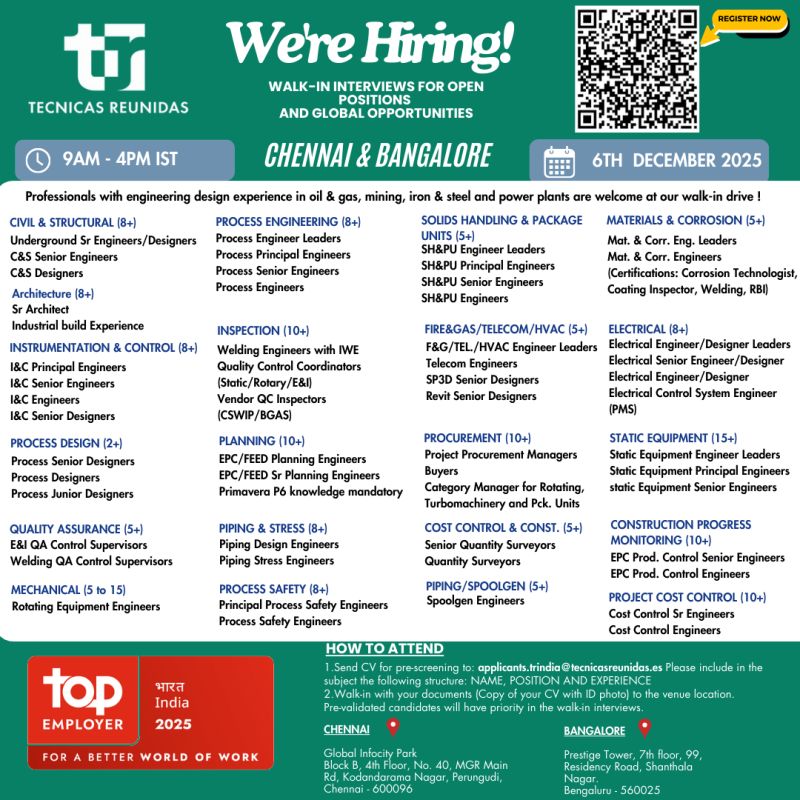
This section presents the necessary details for the Walk-In Interviews: Engineering Jobs in Chennai & Bangalore Dec. at TR India.
| Detail | Description |
| Focus Keyword | Walk-In Interviews: Engineering Jobs in Chennai & Bangalore Dec. at TR India |
| Locations | Chennai and Bangalore, India |
| Job Type | Full-time Positions |
| Industry Focus | Oil & Gas, Power Plants, Mining, Iron & Steel Making, Petrochemicals |
| Eligibility | Experienced Engineers and Designers (Experience years vary per role) |
| Process | Pre-screening is advised. Walk-in interviews for pre-validated candidates have priority. |
| Action | Prepare resume, photo, and required documents. |
Walk-In Interviews: Engineering Jobs in Chennai & Bangalore Dec. at TR India is the time for professionals to connect.
Job Position Descriptions
TR India seeks engineering professionals across multiple disciplines. Experience requirements typically range from 5 to over 15 years, depending on the role. All roles support large-scale EPC projects.
1. Civil and Structural Engineering
This department designs all supporting structures and infrastructure for industrial plants.
- Civil & Structural Engineers: This role creates designs for foundations, roads, drainage, and concrete structures. The engineer performs load calculations and ensures compliance with building codes. The engineer selects construction materials.
- UG (Underground) Engineers: This role focuses on sub-surface designs. The engineer plans utility routing, sewer systems, and underground piping layouts. The engineer coordinates with geotechnical experts.
- CC (Combined Cycle) Power Plant Engineers: This role designs civil and structural elements specific to combined cycle power facilities. The engineer ensures structures support heavy machinery and thermal loads.
2. Process Engineering
Process engineers manage the chemical and physical changes inside the plant.
- Process Engineers / Senior / Principal Engineers: This role develops process flow diagrams (PFDs) and piping and instrumentation diagrams (P&IDs). The engineer performs heat and mass balance calculations. The engineer optimizes plant efficiency.
- Process Safety / Design Engineers: This role focuses on ensuring plant safety. The engineer conducts HAZOP studies and risk assessments. The engineer designs safety systems like pressure relief and flare systems.
3. Piping, Stress & Spooling
This group designs the piping systems that transport materials throughout the plant.
- Piping Design / Stress Engineers & Leaders: This role designs complex piping layouts using 3D modeling software like SP3D or PDMS. The engineer performs stress analysis to ensure pipe integrity against pressure and temperature changes. The engineer creates piping specifications.
- SP3D, PDMS, and SmartPlant Experts: These specialists manage the 3D model environment. They ensure model accuracy and generate necessary drawings and reports.
4. Instrumentation & Control (I&C)
This department manages the plant’s monitoring and automated control systems.
- I&C Principal / Senior Engineers: This role designs control logic and functional specifications. The engineer selects and specifies instruments (transmitters, valves). The engineer manages the control system architecture (DCS/PLC).
- Process Analyzers Specialists: This role specifies online analyzers used for continuous process monitoring. The specialist designs analyzer sample conditioning systems and shelters.
- Smart Plant Instrumentation (SPI-INtools) Administrator: This role manages the company’s master database for instrumentation data. The administrator ensures data integrity and consistency.
5. Electrical Engineering
Electrical engineers design the power supply and distribution systems.
- Electrical Design Leaders / Engineers: This role designs high-voltage (HV) and low-voltage (LV) power systems. The engineer performs load lists, short-circuit studies, and cable sizing. The engineer specifies transformers and switchgear.
- HV System Designers (Above 100kV): This specialist designs substations and transmission lines operating at high voltage levels. The designer ensures proper insulation and clearance.
- ETAP, PMS Experts: These specialists use electrical software (ETAP) for system studies. They manage the Power Management System (PMS) design for power generation facilities.
6. Mechanical Engineering
Mechanical engineers manage static and rotating equipment.
- Static Equipment Engineers: This role designs and specifies pressure vessels, heat exchangers, and storage tanks. The engineer ensures compliance with ASME and other standards.
- Rotating Equipment Engineers: This role specifies pumps, compressors, and turbines. The engineer evaluates vendor bids and reviews performance curves.
7. Other Core Disciplines
- Materials & Corrosion Engineers: This role selects appropriate materials to prevent plant failure. The engineer studies corrosion mechanisms and specifies protective coatings.
- Quality Assurance (QA) Coordinators / Vendor QC Inspectors: This role ensures all materials and equipment meet quality standards. The coordinator reviews inspection test plans (ITPs).
- Planning Senior Engineers / Coordinators: This role develops the project schedule (using Primavera P6 or similar software). The coordinator tracks progress and identifies delays.
- Procurement / Workshop / Office Expeditors: This role ensures timely delivery of equipment and materials. The expeditor monitors vendor schedules and factory acceptance tests.
Top 10 Interview Questions and Answers
Preparing for the Walk-In Interviews: Engineering Jobs in Chennai & Bangalore Dec. at TR India requires preparation. These questions cover basic engineering principles and project execution.
1. Tell us about your role in a recent large-scale EPC project.
2. What is the difference between a PFD and a P&ID?
3. As a Civil Engineer, how do you manage foundation design on poor soil?
4. For a Process Engineer, explain the purpose of a flare system.
5. What are the key elements you look for during a structural steel connection review?
6. Describe a critical tie-in point you managed for a piping system.
7. As an Electrical Engineer, what is the importance of a short-circuit study?
8. Explain the function of an Expeditor in the Procurement process.
9. What are the three main types of heat exchangers and their common applications?
10. What software tools do you use for your discipline?
Engineering Career Growth at TR India
TR India supports employee professional growth. The company provides a platform to work on complex, large-scale international projects. Project experience includes Clean Fuels, Natural Gas, and industrial facility construction. Engineers gain experience with diverse technologies. TR India encourages professional development and learning. The company seeks leaders who improve project execution.
Walk-In Interviews: Engineering Jobs in Chennai & Bangalore Nov at TR India offers a significant career opportunity for skilled professionals in the Engineering, Procurement, and Construction (EPC) sector. TR India, a vital part of the global EPC leader Técnicas Reunidas, is hosting a walk-in drive to recruit experienced engineers and designers for its offices in Chennai and Bangalore. This event targets candidates with specific expertise to contribute to large-scale, international projects in sectors like refining, petrochemicals, and energy transition.
Submit Your Application Here
The Company: TR India (Técnicas Reunidas Engineers India Private Limited)
Walk-In Interviews: Engineering Jobs in Chennai & Bangalore Nov at TR India are an invitation to join one of the world’s foremost engineering and construction companies. Técnicas Reunidas, S.A. (TRSA) is a Spanish-based general contractor providing end-to-end services for industrial and power generation plants.
Company Profile and History
Técnicas Reunidas has a history dating back to 1959. The company specializes in the design, engineering, procurement, and construction (EPC) of complex industrial facilities. With over 60 years of experience, TRSA has successfully delivered more than 1,000 industrial plants in over 50 countries globally. TRSA is a public company based in Madrid, Spain.
TR India Operations
Tecnicas Reunidas Engineers India Private Limited, or TR India, was incorporated in 2011. It serves as one of TRSA’s key global engineering centers, alongside Spain, Abu Dhabi, and Turkey.
- Registration: Incorporated on October 17, 2011, and registered with the ROC Bangalore.
- Location: The registered address is in Bangalore, Karnataka. TR India operates engineering centers in both Chennai and Bangalore.
- Focus: TR India provides high-quality engineering and design services for the group’s global projects, playing a critical role in project execution.

Core Business Sectors
TRSA’s business is structured around major industrial and energy sectors:
- Oil and Gas: Design and construction of refining units, petrochemical facilities, and natural gas processing plants.
- Power Generation: Projects related to thermal, combined cycle, and renewable power generation.
- Energy Transition: Focus on sustainable solutions, including low-carbon hydrogen (Blue and Green), Carbon Capture and Storage (CCS), and bioenergy projects.
- Infrastructure: Specialized projects in areas like metallurgy and environmental engineering.
Walk-In Interview Details
The Walk-In Interviews: Engineering Jobs in Chennai & Bangalore Nov at TR India event offers a direct recruitment path for experienced professionals.
Key Event Information
| Detail | Description |
| Event Focus | Engineering Professionals for EPC Projects |
| Locations | Chennai and Bangalore Offices (Specific venue details will be in the official announcement) |
| Date | 8th November 2025 (Tentative, based on similar past events) |
| Time | 9:00 AM – 3:00 PM IST (Typical timings) |
| Encouraged Candidates | Immediate joiners and candidates with relevant EPC experience. |
How to Attend the Interview
Candidates must follow a clear process for the Walk-In Interviews: Engineering Jobs in Chennai & Bangalore Nov at TR India.
- Pre-Screening (Highly Recommended): Send your updated Curriculum Vitae (CV) for pre-screening to the company’s designated email address for India applicants.
- Email Subject Structure: NAME, POSITION, and YEARS OF EXPERIENCE.
- Document Preparation: Bring a clear copy of your latest updated CV and a recent ID photograph to the venue.
- Walk-In: Attend the interview at the specified date, time, and location. Pre-validated candidates generally receive priority.
Job Positions and Experience Requirements
The Walk-In Interviews: Engineering Jobs in Chennai & Bangalore Nov at TR India targets various engineering disciplines. Experience in the EPC environment, particularly in refining, oil & gas, or petrochemical sectors, is essential.
Process Engineering
Process Engineers design the procedures and equipment necessary to transform raw materials into final products efficiently and safely.
- Job Position: Process Engineer, Senior Process Engineer, Lead Process Engineer
- Experience: 5 to 20+ Years
- Key Responsibilities:
- Perform process simulations and develop process flow diagrams (PFDs).
- Create Piping and Instrumentation Diagrams (P&IDs).
- Calculate heat and mass balances.
- Prepare equipment data sheets and specifications.
- Perform sizing of process equipment like vessels, pumps, and heat exchangers.
Piping Stress Engineering
Piping Stress Engineers ensure the structural integrity of piping systems under various operating and environmental loads.
- Job Position: Piping Stress Engineer, Lead Piping Stress Engineer
- Experience: 8 to 15+ Years
- Key Responsibilities:
- Perform static and dynamic stress analysis for critical lines using software like CAESAR II.
- Develop critical line lists and stress analysis reports.
- Specify, select, and locate pipe supports, including spring hangers and snubbers.
- Review and approve piping general arrangement (GA) drawings and equipment nozzles.
Electrical Engineering
Electrical Engineers design the power generation, distribution, and control systems for industrial plants.
- Job Position: Electrical Engineer, Electrical Design Engineer, Electrical Control System Engineer
- Experience: 5 to 20+ Years
- Key Responsibilities:
- Perform power system studies, including load flow, short circuit, and motor starting analysis, using tools like ETAP.
- Design and specify electrical equipment, including transformers, switchgear, and motor control centers (MCCs).
- Prepare cable sizing, lighting layouts, and grounding specifications.
- Develop protection schemes and relay settings.
Other Potential Engineering Disciplines
The specific roles available in the Walk-In Interviews: Engineering Jobs in Chennai & Bangalore Nov at TR India may include:
- Mechanical (Rotating & Static Equipment): Engineers specializing in machinery like compressors, turbines, vessels, and heat exchangers.
- Instrumentation & Control: Professionals dealing with system automation, control valves, field instruments, and Distributed Control Systems (DCS).
- Civil & Structural: Engineers for plant structures, foundations, and civil works.
- Designers (SP3D/E3D): Specialists in 3D modeling and drafting across piping, electrical, and structural disciplines.
Get instant updates about premium job alerts: 👉 Click to Join WhatsApp Group
Top 10 Interview Questions and Answers
Candidates attending the Walk-In Interviews: Engineering Jobs in Chennai & Bangalore Nov at TR India must prepare technical answers. The following questions cover common areas for EPC engineering roles.
1. Question: What is a P&ID, and how does it differ from a PFD?
3. Question: What is the primary purpose of piping stress analysis?
4. Question: What is the Stress Intensification Factor (SIF) in piping analysis?
5. Question: Describe the components of a typical switchgear.
6. Question: How do you determine the size of a motor control center (MCC)?
7. Question: What is the main difference between an isolation valve and a control valve?
8. Question: Explain the term ‘HAZOP’ in an EPC project.
9. Question: How do you ensure correct material selection for a specific process line?
10. Question: What is the significance of the “Tie-In” point in a brownfield project?
Career Growth and Work Culture at TR India
Joining the Walk-In Interviews: Engineering Jobs in Chennai & Bangalore Nov at TR India means aligning your career with a global industry leader.
Professional Development
TR India places a strong emphasis on continuous growth. The company provides personalized training plans to enhance technical expertise. Engineers gain exposure to diverse, dynamic international projects across various geographies. This continuous professional development ensures employees remain at the forefront of engineering technology.
Global Project Exposure
TRSA executes projects worldwide. TR India engineers contribute to significant global projects in key energy and industrial markets. This exposure offers invaluable experience in working with international teams, meeting stringent global quality standards, and applying best-in-class technologies.
Work Environment
The work culture fosters a diverse and multicultural environment. TR India prioritizes a responsible and ethical management approach. The company promotes work-life balance and labor flexibility, aiming to create a supportive and thriving workplace.
Sobmit Your Application Here