

The Walk-In for Plant Design Engineers | Power & Energy Jobs – L&T S&L event presents a significant opportunity. Walk-In for Plant Design Engineers | Power & Energy Jobs – L&T S&L is actively seeking experienced professionals. These roles support the company’s extensive work in the power sector. This article provides comprehensive details about the company, the job position, and essential interview preparation.
Company Profile: L&T-Sargent & Lundy Limited (L&T-S&L)
L&T-Sargent & Lundy Limited is a specialized engineering and consultancy firm. It is a joint venture between Larsen & Toubro (L&T), a major Indian engineering and construction conglomerate, and Sargent & Lundy L.L.C. (S&L), a global consulting firm based in the USA. The company started in 1995.
History and Expertise
L&T-S&L provides consultancy and engineering design services for the Power and affiliated sectors. Its main design center is located in Vadodara, Gujarat, India. L&T-S&L professionals have extensive experience in power plant engineering and consulting assignments. The company supports projects from concept to commissioning. L&T-S&L has worked on numerous power projects in India and internationally.
Core Business and Services
L&T-S&L focuses on power plant design and engineering. The company’s portfolio includes:
- Coal-Based Power Plants: Sub-critical, supercritical, and ultra-supercritical technology.
- Gas-Based Power Plants: Simple cycle, combined cycle, and cogeneration plants.
- Renewable Energy: Solar, Wind, and Biomass projects.
- Transmission & Distribution (T&D): Substation design and power system studies.
- Specialized Services: Renovation and Modernization, Carbon Capture, Utilization, and Storage (CCUS).

L&T-S&L operates in various roles, including EPC Contractor’s Engineer, Owner’s Engineer, and Lender’s Engineer. The company utilizes a specialized 3D design platform, PLADES (Plant Design Software), customized for power-plant engineering, which enhances project quality and execution.
Job Position: Plant Design Engineers
The Walk-In for Plant Design Engineers | Power & Energy Jobs – L&T S&L targets experienced professionals across several disciplines. The typical experience range for these roles is 5 to 15 years, but the company also welcomes subject-matter experts with higher experience. Experience in manufacturing, commissioning, testing, installation, and execution is generally not considered relevant for these pure design and engineering roles.
Job Description: Plant Design Engineers (Mechanical)
Plant Design Engineers in the Mechanical discipline focus on the physical layout and systems involving equipment and piping.
- Responsibilities:
- Develop 3D modeling of skid frames, pipe routing, and mechanical vessels.
- Design and support of complex process and mechanical piping systems.
- Prepare General Arrangement (GA) drawings and Fabrication drawings.
- Review and comment on vendor drawings.
- Prepare material take-offs (MTO) for cost estimates and procurement.
- Ensure designs follow international codes and standards (e.g., ASME).
- Key Skills: Solidworks, Inventor, AutoCAD, 3D modeling of steel structures and piping.
Job Description: Plant Design Engineers (Electrical)
Plant Design Engineers in the Electrical discipline focus on power systems, equipment, and layouts.
- Responsibilities:
- Perform Detail Engineering for power plants and substations.
- Prepare Technical Specifications for electrical equipment (Transformers, Switchgear, Cables, UPS, etc.).
- Develop Electrical Single Line Diagrams (SLD) and Protection SLDs.
- Execute electrical calculations (Cable sizing, Earthing, Lightning protection, Illumination, Transformer sizing).
- Design layouts: Electrical equipment layout, cable routing layout, earthing, and lightning protection layout.
- Prepare cable schedules and interconnections.
- Key Skills: ETAP, PVsyst, AutoCAD, knowledge of national and international codes (IS, IEC, IEEE).
Walk-In for Plant Design Engineers | Power & Energy Jobs – L&T S&L
Job Description: Plant Design Engineers (Civil & Structural)
Plant Design Engineers in the Civil & Structural discipline focus on the physical structure and foundations of the plant.
- Responsibilities:
- Perform design and engineering for Civil and Structural elements of power plants.
- Focus on foundations, plant structures, and buildings.
- Dynamic foundation analysis for rotating equipment.
- Utilize 3D Designers for structural modeling.
- Key Skills: Tekla, Revit, structural analysis software.
Walk-In for Plant Design Engineers | Power & Energy Jobs – L&T S&L
Job Description: Plant Design Engineers (Control & Instrumentation – C&I)
Plant Design Engineers in the C&I discipline focus on the control and monitoring systems.
- Responsibilities:
- Perform Basic and Detail design engineering for C&I systems in power plants.
- Focus on DCS/PLC engineering.
- Perform sizing of Control Valves, Flow Elements, and Thermowells.
- Prepare Loop Diagrams and Logic Diagrams.
- Design physical layouts like the Central Control Room (CCR) and create installation drawings and hook-up drawings.
- Key Skills: DCS/PLC systems, knowledge of control valve and flow element sizing.
Walk-In for Plant Design Engineers | Power & Energy Jobs – L&T S&L
SEO Focus: Walk-In for Plant Design Engineers | Power & Energy Jobs – L&T S&L
The core focus keyword is: Walk-In for Plant Design Engineers | Power & Energy Jobs – L&T S&L. This keyword appears prominently:
- SEO Title: Walk-In for Plant Design Engineers | Power & Energy Jobs – L&T S&L
- Beginning of Content: The Walk-In for Plant Design Engineers | Power & Energy Jobs – L&T S&L event presents a significant opportunity. Walk-In for Plant Design Engineers | Power & Energy Jobs – L&T S&L is actively seeking experienced professionals.
- Subheadings:
- Job Position: Plant Design Engineers
- SEO Focus: Walk-In for Plant Design Engineers | Power & Energy Jobs – L&T S&L
- Content Density: The keyword is integrated frequently throughout the article.
Get instant updates about premium job alerts: 👉 Click to Join WhatsApp Group
Walk-In for Plant Design Engineers | Power & Energy Jobs – L&T S&L
Top 10 Interview Questions and Answers for Plant Design Engineers
Preparing for the Walk-In for Plant Design Engineers | Power & Energy Jobs – L&T S&L event requires technical knowledge. Here are ten important questions for Plant Design Engineers, particularly in the power sector.
1. What is the fundamental difference between Basic Engineering and Detail Engineering in a power plant project?
2. (Mechanical) Explain the importance of the Pipe Stress Analysis. What key inputs do you need?
3. (Electrical) What factors do you consider when sizing a power cable for a motor in a power plant?
Ampacity: The cable must safely carry the continuous load current.
Voltage Drop: The voltage drop at the motor terminal must be within permissible limits (usually 3% or 5%). A high drop impacts motor starting and performance.
Short-Circuit: The cable must withstand the thermal and mechanical stresses from a bolted fault current for the duration of the protection clearing time. Other considerations include installation method, ambient temperature, and grouping factor.
4. (Civil & Structural) How do you account for dynamic loading when designing the foundation for a turbogenerator?
5. (C&I) Differentiate between a DCS (Distributed Control System) and a PLC (Programmable Logic Controller) in a large power plant application.
- Answer: A DCS handles the main control and monitoring of large, continuous processes (like a boiler or turbine). It offers redundancy, advanced control strategies, better operator interface, and system-wide integration. A PLC handles high-speed, discrete control logic and sequencing (like a soot blower or a burner management system). PLCs are better for fast, repetitive tasks. In a power plant, the DCS typically oversees the PLCs.
6. What is a P&ID and what crucial information does it convey to a Plant Design Engineer?
Process flow and control logic.
Equipment identification and type (e.g., pumps, vessels, heat exchangers).
Line sizes, pipe classes, and material of construction.
Location and type of all instruments, valves, and fittings.
7. Describe the process of technical bid evaluation for a major piece of power plant equipment, such as a Heat Exchanger.
Comparison of Guarantees: Compare performance guarantees (e.g., thermal rating, pressure drop) among vendors.
Compliance Check: Verify all specifications, codes, and standards are met.
Review of Exceptions/Deviations: Analyze all points where the vendor deviates from the specification.
Clarity and Discussion: Issue Technical Queries (TQs) to the vendor to resolve ambiguities.
TBE Report: Document the findings and provide a recommendation for technical acceptance or rejection.
8. (Mechanical) What is the function of an HRSG and where is it typically used in power generation?
9. (Electrical) Briefly explain the concept of Earthing and Lightning Protection in a power plant design.
10. How does 3D modeling software like PLADES or similar tools benefit the Plant Design Engineer in project execution?
Clash Detection: It automatically identifies interference between different disciplines (piping, structure, electrical raceways). This reduces costly rework during construction.
Visualization: It provides clear visualization of the final plant, helping with design reviews and constructability studies.
Accurate Material Take-Off (MTO): The model can generate accurate material lists, aiding in procurement and cost control.
Layout Optimization: It helps optimize equipment layout and accessibility for maintenance
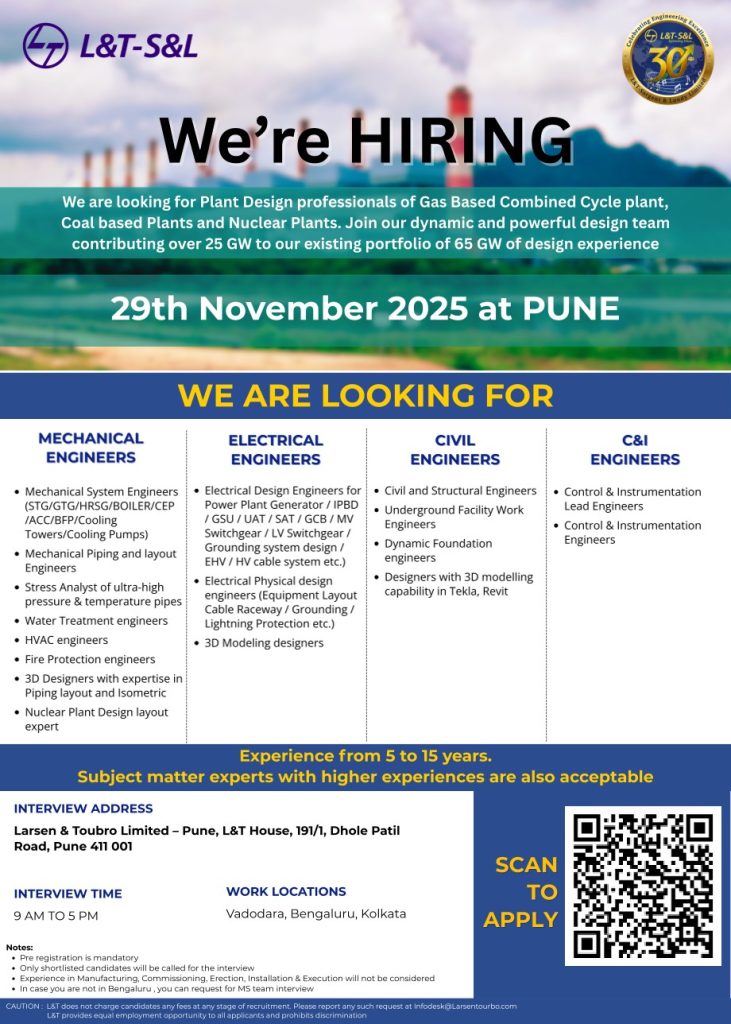
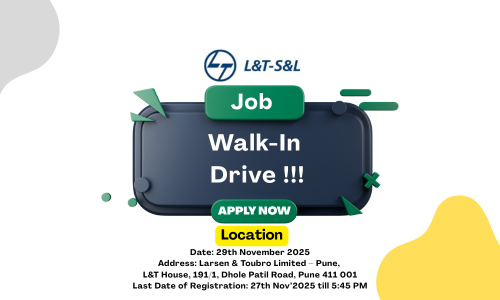
Date: 29th November 2025
Address: Larsen & Toubro Limited – Pune, L&T House, 191/1, Dhole Patil Road, Pune 411 001
Last Date of Registration: 27th Nov’2025 till 5:45 PM
Register yourself and apply by clicking